Our Office
4833 Bethesda Ave
Suite 302
Bethesda, MD 20814
Visit Us Online


When tooth structure is eaten away or otherwise damaged by dental decay, cracks, or fractures, it's often repaired with the placement of a composite filling. While traditional fillings were typically composed of amalgam, a mixture of different metals, today's restorations are mercury-free, biologically safe, and tooth-colored.
In addition to restoring teeth affected by damage or decay, strong and durable composite resins can also be used to cosmetically change the size, color, or shape of teeth with imperfections or minor alignment issues such as spacing.
When decay, cracked fillings, root canals or clenching and grinding of the teeth have caused extensive damage to the underlying tooth structure, a dental filling may not be a sufficient restoration. The only way to completely restore the function of this tooth is often full coverage with a crown. The good news is that a completed crown looks and feels like a natural tooth.
In addition to restoring a single natural tooth, crowns can be used in other situations including being the supporting ends of a dental bridge, as a dental implant restoration, or as coverage for a cracked tooth to prevent further breakdown.
Losing a tooth due to injury, dental decay, or gum disease can happen. When teeth are missing, a series of changes that can impact your overall dental health and jaw function may begin to develop. The adjacent teeth may start to drift or tilt into the space, and teeth in the opposing jaw may start to shift toward the area of the missing tooth. It is, therefore, essential to replace either the single tooth or multiple teeth that are missing from this area
Out of all the restorative choices available today, an implant comes the closest to replicating the look, feel and function of a natural tooth. Furthermore, it is the only method of tooth replacement that does not require the involvement or preparation of the adjacent teeth. A dental implant also stimulates bone remodeling to prevent shrinkage in areas where teeth are missing and helps to restore facial contours in areas where significant bone loss has occurred. Ultimately, dental implants serve both functional and aesthetic purposes, enabling patients to eat better, speak better and create a beautiful smile.
This remarkable technique requires only 4-6 implants to support all the replacement teeth for that dental arch. Also known as All-on-4® concept*, it typically involves only one procedure to place all the implants, often avoids the need for additional bone grafting procedures, and provides the instant gratification of receiving a full set of temporary teeth immediately on the same day as the initial procedure.
As a permanent fixed replacement for all the teeth, the All-on-4® dental implant technique achieves unprecedented results with a minimal number of dental implants and surgical procedures, thereby making it an appealing cost-effective solution for permanently replacing a full set of teeth.
Ultimately, implant retained dentures serve both functional and aesthetic purposes, enabling patients to eat better, speak better and create a beautiful smile.
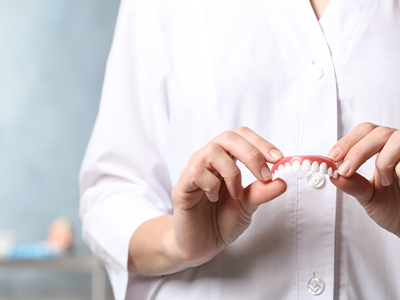
Dentures and partials are removable, yet natural-looking dental appliance that helps restore function by replacing one or all missing teeth and physical appearance. Partial dentures are made from a combination of metal and acrylic – which gives them the strength to handle your needs for chewing and speaking, while also looking natural.
Dentures and partials do require a bit of maintenance but do an excellent job of restoring beauty and functionality to that part of your mouth. Daily cleaning of your partial denture is vital but is a simple process that will keep your gums healthy and your partial denture looking great.
While our goal is always to save teeth, there are circumstances under which a tooth is no longer viable and needs to be extracted. When a tooth is so broken or damaged it’s beyond repair, there is advanced periodontal disease and severe bone loss or there is a need to eliminate crowd for orthodontic purposes an extraction may be the only option.
If you’re facing a tooth extraction, it can seem a little daunting and nerve-wracking, and we’re here to help. From nitrous oxide to single-tooth anesthesia, we can help ease your fears and make the procedure as pain-free as possible.
There are times that a bridge is the best option to restore full function to a small area of the mouth. A dental bridge replaces the missing teeth by “bridging” the gap between your natural teeth.
Often, a dental bridge is an alternative to partial dentures. This is appealing to many patients since a bridge is a fixed replacement option and not removable like partials.
Chronic jaw clenching and grinding is called bruxism. While it can happen any time of day, it usually occurs at night causing an individual to wake up with any number of symptoms including jaw pain, headaches, and sore teeth that may feel loose. Although, stress and anxiety are the most common causes of bruxism there may be other contributing factors such as a sleep disorder, an abnormal bite, as well as teeth that are missing or poorly aligned.
To help alleviate the symptoms of bruxism, wearing a night guard while sleeping is frequently recommended. This appliance is designed to relieve excessive pressure on the jaw joint (TMJ), reduce muscle strain and eliminate jaw pain.
The process of full mouth reconstruction often involves rebuilding and/or replacing many, if not, all teeth to restore function and beauty.
Many times, patients that need full mouth reconstruction have been functionally and cosmetically debilitated by extensive tooth loss, dental trauma, dental decay, dental habits, TMJ jaw-joint disorders, grinding their teeth, have suffered the effects of long-term acid erosion of tooth structure, or been affected by medical conditions or therapies involving the head and neck area.